Parade

8.12.2010


Just five days after watching the Pride event here in Amsterdam, I spent last night at an entirely different sort of Parade - the succinctly named "Parade".

Parade is a pretty unique event that is held annually in Holland's four largest cities - Rotterdam, Den Haag, Utrecht and Amsterdam. It is a collection of temporary restaurants and bars all centered around small performances (mainly short plays) held in tents by amateurs and professionals.

There is also a silent disco - where a DJ spins tunes and everyone wears special headphones, so while they boogie and occasionally let out a big "whooo", the observers on the outside hear nothing and basically watch a bunch of temporarily insane people get down. It's hilarious to watch.


The whole event is the embodiment of the Dutch word gezellig (note to non-Dutch speakers - you will injure yourself if you try to pronounce it). Essentially, "cozy" is a close translation but also somewhat lame-sounding - as with so many foreign words there is no direct meaning in another tongue.

Sitting in Martin Luther King Park, with the Amstel river snaking past, it is an annual favourite of many Amsterdammers who come to see and be seen, drink and be drunk (and many sheepishly admit to not even checking out any performances - and with all the fun outside, it's tough to blame them). I will add to the sheepishness - although there are still 10 days left to check out a show or two. It runs for two weeks every August.

The gezellig part has to do with the arrangement of all the tents, temporary cafes, and communal picnic tables nestled in the trees, enclosed around you like a big neighborhood.

And in a YouTube, Twitter, and home theatre world, it's also nice to be occasionally entertained in analogue mode instead of digitally.

The list of performances

The performers do small bits outside to entice people to come in for their show
(This one? Not so enticing)


Going to the bathroom for a good cause


G-hey!

8.08.2010


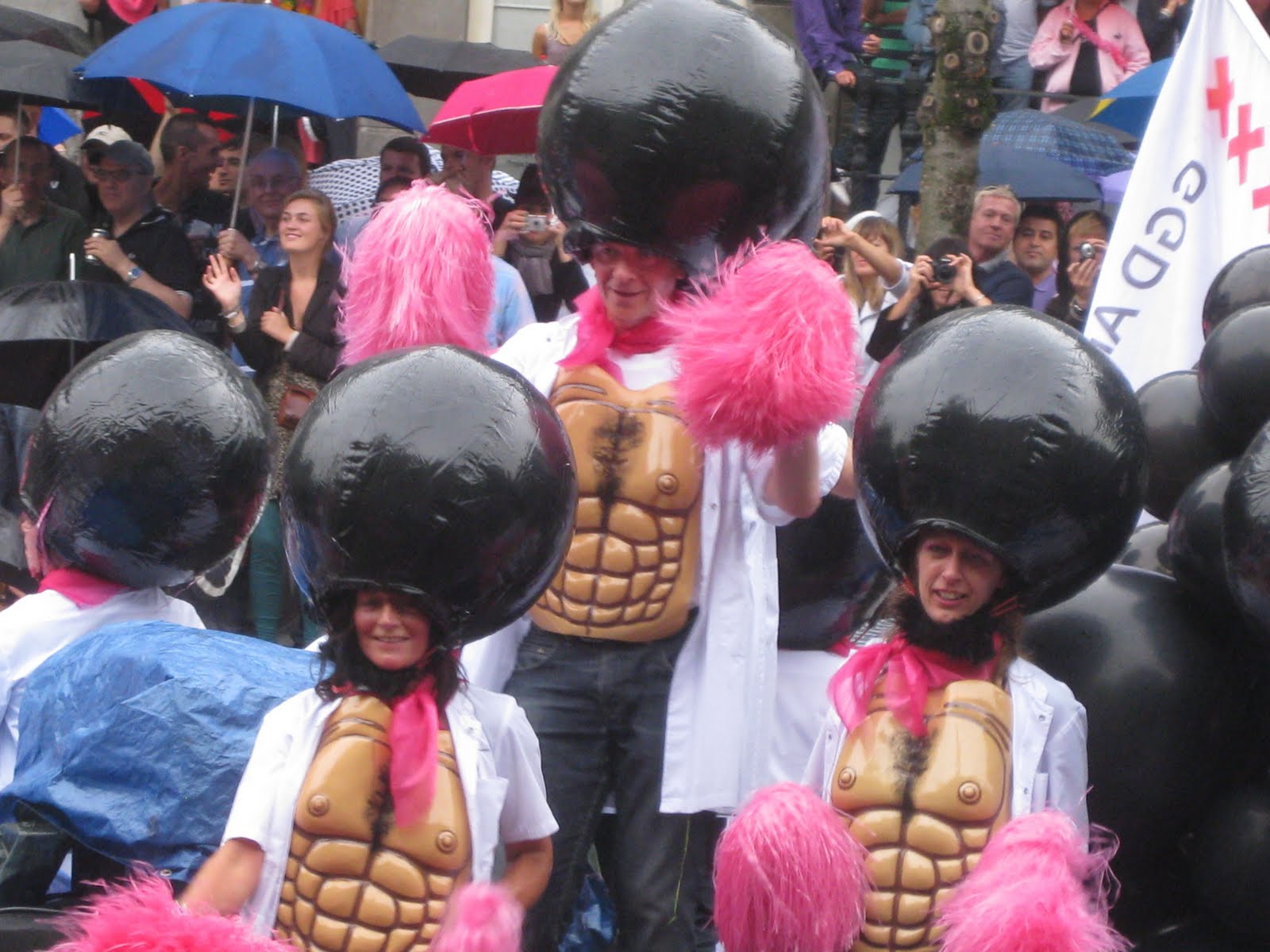
Amsterdam has long been known as a gay-friendly city (it used to hold the unofficial title of Europe's Gay Capital). With mostly excellent tolerance, progressive thinking and a mayor named Eberhard and a deputy mayor named Asscher (yes, sometimes this stuff writes itself) it is a perfect place for a boisterous and booming Pride Parade.

It was a great day, albeit pretty rainy. Float after float drifted by on the canals, with mostly booming techno music (although some classical music and Dutch folk lietjes also drifted past) and the gay, lesbian, tranny, and impossible-to-label categories all in fine form.

It was an all-inclusive event. Tons of families, older folks and everyone in-between were lining the bridges and the very happy crowd lining the Prinsengracht (more like the Princessgracht, in many cases) canal.

The Netherlands, as I've seen time and again at big events, is for the most part incredibly inclusive (politics aside) for spectators and participants alike. In particular for the Amsterdam Pride Parade, you see company-sponsored floats celebrating gay employees for banks, electronics multinationals, and even the police force.

It was a very similar feel to the Queen's Day celebrations held in April - basically hours and hours of dancing on the boats and in the streets, with everyone completely positive and upbeat.

As a breeder, one has to tread delicately when writing about this stuff. On the one hand, you want to be culturally sensitive, especially when discussing a minority whose experiences and challenges are well outside your level of knowledge.

On the other hand, providing mainstream acceptance also means you should be able to poke fun at the subject just like anything else when the situation calls for it (like say, Mel Gibson, or hipsters).

So without further ado, some images from Saturday, August 7th in Amsterdam. It was another very fine day.


Pre-parade

Pre-parade

Amsterdam city float, with mayor Eberhard van der Laan in the foreground


I'm having nightmares...

...and I suspect more are forthcoming


Le freak, c'est sheik

A moment of reflection... "Too subtle?"

"We have no idea either! But yay parades!"


The police force float


Check out that guy's hat!


Lessons

8.06.2010


The life of a travel-addicted person has its own lessons and rewards. Some thoughts from the past few months:

  • If you are under 30 and living in North America, leave for a while to go to Europe. Live in Paris, Amsterdam, Lisbon, Barcelona, almost anywhere. Don't think, just go. People and culture are 99% the same anywhere in the world, but the 1% that is different is significant and needs to be experienced. Life here is many ways much richer, more interesting and more layered.
  • Same as the above if you are under 50. Or 100, for that matter. You might just opt for a few less parties and a few nicer places to sleep, but the richness of the experience is the same.
  • There's something to be said for staying put. And there's something to be said for moving around.
  • There are certain things we don't, and may never, have an answer for... why, in a city as amazing as Paris or while traveling themselves, are the French so miserable? Why, in a society as pragmatic as Holland, is hot tea often served in a cup with no handles? Why do the Spanish and Portuguese not pick up after their dogs? Why is Paul Rudd famous at all? Some things we may never know.
  • Trade-offs. More orderly, poop-scooping North America is on time, has safety helmets and bigger dwellings, but can bore one to tears. Meanwhile in the EU, babies being held in one hand while the parent is biking, still-rampant cigarette smoking and trucks that back up with no beeping seem to be the price for a more exciting society. Trade-offs.
Happy to hear your comments, as always.

Lisbonita III

8.03.2010


The direct approach works!


This is how someone can spend 24 hours in Lisbon... (or how someone, getting older, can also cheat and put the activities of two days into one).

  • Wake up around 5am because of the heat, and then drift in and out till 8am as you realize, "Hey, I'm in Lisbon - I can chill."

  • Eat pasteis in the morning, small delicious pastries that you can find everywhere in Lisbon, and especially at the Pasteis de Belem, where lineups occur out the door every day.

(Not an original photo - I ate mine too fast)

  • Take a morning tram ride on the ubiquitous Tram 28, with all open windows and streets so narrow and winding that you get the sense you're on a slow-moving roller coaster. Tourists and local alike are here. In fact, most places in Lisbon seem to retain their authenticity by not being solely tourist-populated.

  • Make a trip to the Panteao Nacional, for some history lessons, spectacular rooftop views, culture, and cool respite from the mid-day heat.

Panteao Nacional

  • Go for a mid-afternoon stroll through the streets of Alfama, all winding and twisting with elderly ladies debating issues across the street from their neighbours, looking a little like happy prisoners taking to their cellmates.

An inmate at Alfama, making a point

  • Wade over to Oceanario, the sleek and impressive aquarium of Lisbon, with a big-time message of conservation that seems to have a little more weight behind it with the recent disaster in the Gulf of Mexico. Hundreds of fish and types of sea life here, including some impressive sharks and freaky-looking sea dragons.
Oceanario

Oceanario

  • Spend early evening at Miradorou do Adamastor, with families, friends, couples, classy older ladies and raving drunks all sitting atop a lookout over the city and the river. Here you can buy beer and other drinks and soak in the views.

Miradorou do Adamastor

  • Dinner follows in Bairro Alto, where it is about as touristy as Lisbon gets - that is to say, you'll see more foreigners here but it's not an over-the-top trap. Grilled sardines, the first non-meat meal I've had in 10 days. It was in Portugal that I was introduced to picanha by a friend - essentially four slabs of salty meat. On more than one occasion in recent weeks I happily had the meat sweats, barely discernible from the heat sweats.
  • At night you can stop at the Miradorou de Sao Pedro de Alcantara, with amazing views over the city amid statues and fountains. You could easily spend the whole evening here, drinking porto and watching the sunset. It's in the Bairro Alto area, a happening area with hundreds of restaurants and bars along twisting, hilly, narrow cobblestone streets.
From Miradorou de Sao Pedro de Alcantara

  • Late at night, it's off to Lux, a massive waterfront bar with a rooftop patio that overlooks the river, and two more levels including a thumping basement dancefloor. It's apparently partly-owned by John Malkovich, which for some reason made me feel cooler. But not younger.
  • Grab a cheap (and refreshingly scam-free) taxi back to Belem at 5am.


Lisbonita II

8.01.2010


Images from Lisbon above and below, with the warmth and kind spirit of the Portuguese people (new friends, restaurant owners, businesspeople, old folks and little kids) making it a great 12 days.

But as some important choices loom in my own life and in the lives of a few good friends who have contacted me in recent weeks to express their own restlessness and angst despite being very comfortable materially, here are some wise words I came across from Paulo Coelho's blog. On a Sunday afternoon, no less.

A reminder, a warning, a salvation, a meaningless ramble, an overly morbid outlook on things? Depends on your current state of mind:

The first symptom of the process of our killing our dreams is the lack of time. The busiest people I have known in my life always have time enough to do everything. Those who do nothing are always tired and pay no attention to the little amount of work they are required to do. They complain constantly that the day is too short. The truth is, they are afraid to fight the Good Fight.


The second symptom of the death of our dreams lies in our certainties. Because we don’t want to see life as a grand adventure, we begin to think of ourselves as wise and fair and correct in asking so little of life. We look beyond the walls of our day-to-day existence, and we hear the sound of lances breaking, we smell the dust and the sweat, and we see the great defeats and the fire in the eyes of the warriors. But we never see the delight, the immense delight in the hearts of those who are engaged in the battle. For them, neither victory nor defeat is important; what’s important is only that they are fighting the Good Fight.


And, finally, the third symptom of the passing of our dreams is peace. Life becomes a Sunday afternoon; we ask for nothing grand, and we cease to demand anything more than we are willing to give. In that state, we think of ourselves as being mature; we put aside the fantasies of our youth, and we seek personal and professional achievement. We are surprised when people our age say that they still want this or that out of life. But really, deep in our hearts, we know that what has happened is that we have renounced the battle for our dreams – we have refused to fight the Good Fight.


When we renounce our dreams and find peace, we go through a short period of tranquility. But the dead dreams begin to rot within us and to infect our entire being. We become cruel to those around us, and then we begin to direct this cruelty against ourselves. That’s when illnesses and psychoses arise. What we sought to avoid in combat – disappointment and defeat – come upon us because of our cowardice.


And one day, the dead, spoiled dreams make it difficult to breathe, and we actually seek death. It’s death that frees us from our certainties, from our work, and from that terrible peace of our Sunday afternoons.


A quick detour to Africa in the midst of the trip...

...or was it? do-do do-do, do-do do-do (Twilight Zone music).
This appeared in the tropical gardens of Belem, a suburb of Lisbon

More from the tropical garden in Belem

The 25 de Abril Bridge, connecting Lisbon to Almada. Built by the same company that built the Bay Bridge (not the Golden Gate) in San Francisco

Vasco, from Oceanario (Lisbon's aquarium, the second largest in Europe)